
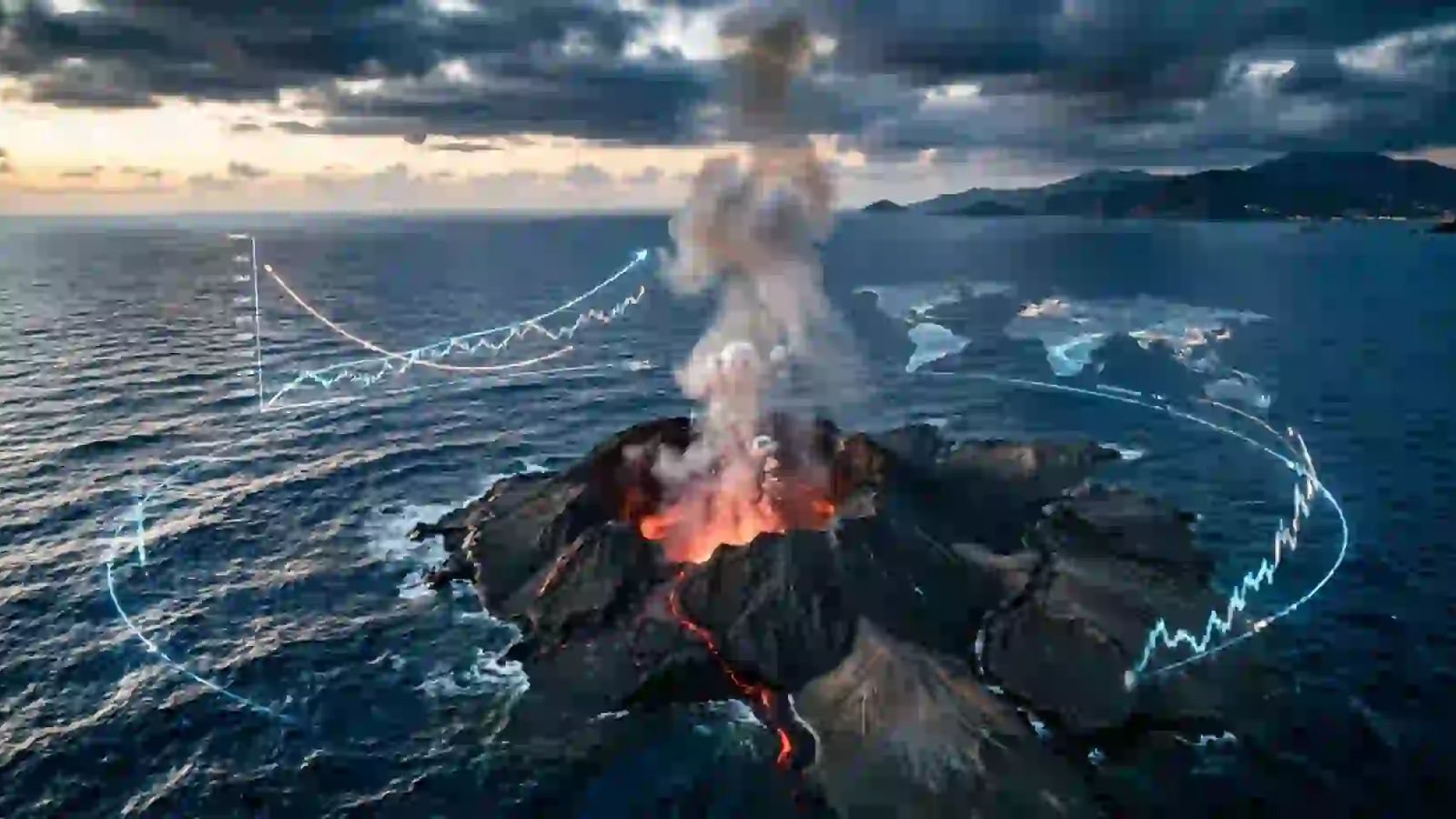
A Mediterranean volcanic event would not need to become a global catastrophe to become a financial problem. The real risk lies in how a physical shock could move through tourism, aviation, shipping, insurance, energy, inflation, monetary policy, and household finances.
Executive Summary
The Mediterranean is normally associated with tourism, shipping, energy routes, food production, and some of the world's most important coastal economies. Beneath parts of the region, however, lies a geological system capable of producing earthquakes, volcanic activity, submarine landslides, and, under certain circumstances, tsunamis.
This article does not predict that a major Mediterranean submarine volcano is about to erupt.
It examines a different question:
What could happen to markets and household finances if a significant submarine volcanic event occurred somewhere in the Mediterranean?
The distinction matters.
Scenario analysis is not forecasting. It is a way of understanding how an unexpected event could propagate through an economic system before investors are forced to react to it.
The Mediterranean contains documented submarine volcanic systems, including the Kolumbo volcanic complex near Santorini. Scientific research has established that the region has experienced major explosive eruptions and tsunami-generating events in the past. More recent research has also examined seismic and tectonic activity around the Santorini–Amorgos region. None of this, by itself, establishes that a major eruption is imminent.
The economic question is therefore not whether a volcano will erupt tomorrow.
It is what the financial system would do if one did.
The Risk Beneath the Map
Financial markets are designed to process information.
They are considerably less comfortable processing uncertainty.
A volcanic eruption would begin as a physical event. But the financial consequences would depend on the economic network surrounding it.
The first shock might involve evacuations, infrastructure damage, coastal disruption, or temporary closure of airports and ports.
The second shock could involve tourism.
The third could involve aviation, shipping, insurance, food supply chains, and energy.
The fourth could arrive through prices.
The fifth could reach monetary policy.
And the final transmission mechanism could be financial markets themselves.
This creates a simple principle:
The size of the physical event would not necessarily determine the size of the financial shock.
Economic exposure, network concentration, insurance coverage, supply-chain dependence, and investor expectations could amplify or reduce the initial disturbance.
A Volcanic Event Is Not a Market Forecast
It is important to establish the boundary between evidence and speculation.
The Mediterranean contains active and historically active volcanic systems. Kolumbo, a submarine volcano northeast of Santorini, produced a major explosive eruption in 1650 that generated a destructive tsunami in the Aegean.
Scientific studies have also investigated seismicity and tectonic processes around the Santorini–Amorgos region.
These facts establish that volcanic and seismic hazards exist.
They do not establish that a major submarine eruption is currently approaching.
There is no responsible basis for presenting a hypothetical eruption as an imminent event.
The purpose of this analysis is therefore conditional:
If a significant Mediterranean volcanic event occurred, which economic channels would transmit the shock into financial markets?
That is a very different question.
The First Transmission Channel: Tourism
Tourism would probably be one of the earliest economic sectors affected.
The Mediterranean economy contains an enormous concentration of coastal tourism infrastructure. Hotels, restaurants, airlines, cruise operators, transportation companies, retailers, and local service businesses all depend on predictable access to popular destinations.
A volcanic event would immediately alter that assumption.
Even without extensive physical destruction, the perception of danger could be enough to change travel decisions.
This distinction is critical.
Modern economies do not require physical destruction for economic activity to fall.
They require only a sufficiently large change in behavior.
If travelers postpone vacations, airlines reduce capacity, cruise operators alter routes, hotels experience cancellations, and international tourists redirect spending toward other destinations, the economic effect can begin before major infrastructure is damaged.
For households, the impact would appear indirectly.
- Workers in tourism-dependent regions could experience reduced income.
- Businesses could face lower revenues.
- Local governments could collect less tax revenue.
- Banks could eventually experience higher credit risk among heavily exposed businesses.
The first market reaction might therefore occur in sectors that appear geographically distant from the volcano itself.
The Second Transmission Channel: Aviation
Volcanic ash represents a particularly important economic transmission mechanism.
Aircraft engines and volcanic ash are incompatible.
Even an eruption that causes limited ground damage could create significant disruption if ash enters major aviation corridors.
Flight cancellations can propagate quickly.
- An aircraft delayed in one location may be unavailable for another flight.
- Crew schedules can become disrupted.
- Airports can experience congestion.
- Cargo movements can be delayed.
- Perishable goods can become more expensive.
- Business travel can decline.
- Tourism can weaken further.
The important point is that aviation behaves as a network.
A disruption in one geographic location can therefore produce consequences far beyond the physical boundaries of the original event.
This is why investors should not evaluate the risk simply by asking:
How much land did the eruption damage?
The more relevant question is:
Which economic networks became temporarily unavailable?
The Third Transmission Channel: Mediterranean Shipping
The Mediterranean is not merely a tourism region.
It is a major commercial corridor connecting Europe, North Africa, the Middle East, and global maritime trade.
A significant disruption to a strategically important port, shipping route, or coastal logistics network could create delays that propagate through supply chains.
- Shipping costs could increase.
- Insurance premiums could rise.
- Cargo could be rerouted.
- Delivery times could lengthen.
- Companies carrying low inventories could become particularly vulnerable.
The economic effect would depend heavily on location.
A localized volcanic event with no meaningful effect on major shipping infrastructure could have little impact on global trade.
A geographically strategic event could be very different.
This is one of the reasons scenario analysis must distinguish between physical severity and economic exposure.
The Fourth Transmission Channel: Energy
Energy would be one of the most closely watched markets.
The Mediterranean is connected to important energy infrastructure, including ports, pipelines, storage facilities, refining capacity, and maritime routes.
A volcanic event would not automatically cause an energy crisis.
That assumption would be irresponsible.
But if the event disrupted a strategically important infrastructure node at the same time as geopolitical tensions or tight inventories, the market response could become disproportionately large.
This is where financial amplification becomes important.
Markets price future availability, not merely current supply.
If traders believe that an event could reduce future energy availability, prices may react before physical shortages actually occur.
The same principle applies to natural gas, refined petroleum products, electricity, and transportation costs.
A relatively small physical disruption can therefore produce a larger price response when inventories are low and market expectations are already fragile.
The Fifth Transmission Channel: Insurance
Insurance could become one of the most interesting financial transmission mechanisms.
A major natural catastrophe would create claims.
But the financial impact would not end with the claims themselves.
- Insurers would reassess geographic exposure.
- Reinsurers could reprice catastrophe risk.
- Property premiums could rise.
- Businesses in exposed regions could face higher insurance costs.
- Some forms of coverage could become more difficult or expensive to obtain.
The long-term effect could therefore continue after the physical event had disappeared from the headlines.
This is a recurring characteristic of catastrophe economics.
The disaster occurs on one date.
The repricing of risk can continue for years.
The Sixth Transmission Channel: Food and Consumer Prices
The Mediterranean is deeply integrated into European food supply chains.
A major disruption could affect agriculture, ports, transportation, tourism-related food demand, and regional logistics.
The direct effect would depend on the location and duration of the disruption.
But the market mechanism is straightforward.
If transportation becomes more expensive, supply becomes less reliable, or certain agricultural regions experience physical damage, wholesale prices can rise.
Consumers would eventually encounter the shock through higher prices.
For households, this is where a seemingly remote geological event becomes economically personal.
The average citizen does not need to own a hotel, airline, shipping company, or energy producer to feel the consequences.
They may simply pay more for transportation, food, insurance, or travel.
A Conceptual Market-Risk Equation
The economic consequences of a volcanic event can be represented using a simple conceptual framework:
$$S = G \times E \times X \times F$$
where:
$$G = \text{Physical Severity}$$
$$E = \text{Economic Exposure}$$
$$X = \text{Transmission Intensity}$$
$$F = \text{Financial Amplification}$$
Here, $S$ represents the potential systemic economic shock.
This is not a forecasting equation and should not be interpreted as a scientific model capable of predicting losses.
Its purpose is analytical.
A severe physical event in an economically isolated location may produce a manageable financial response.
A moderate physical event affecting a strategically important transportation or energy node could produce a much larger market reaction.
The relationship can therefore be counterintuitive.
Physical magnitude is only one component of financial magnitude.
What Could Happen to a Western Household Portfolio?
This is where the hypothetical scenario becomes relevant to ordinary investors.
Consider a diversified Western household holding a mixture of equities, bonds, cash, property exposure, and retirement assets.
The first reaction might appear in equity markets.
Travel companies, airlines, hotels, cruise operators, insurers, and selected transportation businesses could face immediate pressure.
Energy companies could move in the opposite direction if investors expect supply constraints.
Defensive assets could attract capital if uncertainty rises.
Government bonds could initially benefit from a flight to safety.
But if the event produced persistent inflation through energy, food, or transportation costs, the bond response could become more complicated.
This is the critical point.
A short-lived shock and a persistent inflation shock are not the same portfolio problem.
Scenario A: Limited Disruption
A localized eruption occurs. Authorities contain the situation. Major shipping routes remain open. Air traffic is disrupted only temporarily. Tourism recovers relatively quickly.
In this scenario, the market reaction could be sharp but short-lived.
Potential portfolio effects:
| Asset or Sector | Possible Initial Effect | Main Reason | |---|---|---| | Airlines | Negative | Flight disruption and higher operating costs | | Tourism | Negative | Cancellations and weaker demand | | Shipping | Mixed | Temporary disruption and rerouting | | Energy | Mixed | Risk premium without major supply loss | | Government bonds | Potentially positive | Initial flight to safety | | Gold | Potentially positive | Safe-haven demand | | Broad equities | Mildly negative | Risk-off positioning |
This would primarily be a risk-premium event.
Scenario B: Regional Economic Disruption
The event disrupts tourism, aviation, ports, and selected infrastructure for an extended period.
The market would have more time to price second-order effects. Potential portfolio effects could include:
- Weaker earnings for exposed companies;
- Higher transportation costs;
- Higher insurance premiums;
- Stronger demand for defensive assets;
- Greater volatility in energy markets;
- Pressure on regional currencies or sovereign spreads where fiscal exposure is high.
The event would no longer be simply geological. It would become a regional macroeconomic shock.
Scenario C: Systemic Supply Shock
This is the most severe scenario.
A major event coincides with already-tight energy markets, geopolitical tensions, fragile supply chains, or weak inventories.
The physical event becomes an amplifier rather than the sole cause of the financial stress.
- Inflation rises.
- Growth expectations fall.
- Central banks face a difficult policy choice.
Markets begin to price the possibility of slower growth combined with higher prices.
This is the scenario in which traditional diversification can become less effective because several asset classes are responding to the same macroeconomic shock.
The Inflation Problem
The most dangerous economic combination is not necessarily a recession.
It is a shock that simultaneously reduces economic activity and increases prices.
A Mediterranean catastrophe could theoretically produce such a combination if transportation, energy, food, insurance, and logistics costs increased while tourism and regional business activity weakened.
The result would resemble a supply shock.
Central banks would then face an uncomfortable dilemma.
If inflation rises, monetary policy normally becomes more restrictive.
But if economic activity is simultaneously weakening, aggressive tightening can increase the economic damage.
This creates the possibility of a policy trade-off:
Inflation versus growth.
For investors, this distinction matters enormously.
A normal recession can support expectations of lower interest rates.
An inflationary supply shock can make that response much more complicated.
What Happens to Gold?
Gold would likely attract attention during a severe geopolitical or systemic risk event.
But it should not be described as a guaranteed winner.
Gold can rise when investors seek monetary insurance and protection from uncertainty.
It can also fall during liquidity crises if investors sell assets to raise cash.
The more intellectually defensible conclusion is therefore conditional:
A major Mediterranean shock could increase demand for gold if investors interpret the event as evidence of broader monetary, geopolitical, or systemic fragility.
That is very different from saying that gold must rise.
What Happens to Equities?
The equity market response would probably be highly uneven.
A broad index can hide enormous differences between individual companies.
- An airline may face rising fuel and operational costs.
- A defense company may experience stronger demand.
- A hotel chain could suffer from falling occupancy.
- A global technology company with limited Mediterranean exposure might experience almost no direct operational impact.
- An energy producer could benefit from higher commodity prices.
- An insurer could face higher claims.
This is why scenario analysis should focus on transmission channels, not simply on whether “stocks go down.”
Markets are collections of businesses.
The economic effect depends on which businesses are exposed.
The Citizen's Portfolio Is Really a Household Balance Sheet
The most overlooked part of catastrophe economics is that households do not experience financial shocks only through investment accounts.
They experience them through their entire balance sheet.
A household can simultaneously face:
- Higher energy bills
- Higher food costs
- Higher insurance premiums
- Higher transportation expenses
- Lower property demand in exposed regions
- Weaker employment conditions
At the same time, retirement assets may become more volatile.
This means that financial resilience is not simply about maximizing investment returns.
It is about maintaining enough diversification, liquidity, and flexibility to survive an unexpected change in the economic regime.
The Probability Question
There is an important distinction between probability and consequence.
An event can have a relatively low probability while still deserving serious analysis if its potential consequences are large.
This is the logic behind catastrophe insurance, emergency planning, financial stress testing, and central-bank scenario analysis.
The existence of a low-probability risk does not mean investors should trade aggressively on it.
It means the risk should be understood.
This distinction is especially important for natural hazards.
The responsible question is not:
“Will this happen?”
The responsible question is:
“If this happened, where would the financial system be most vulnerable?”
Why the Mediterranean Matters Beyond the Mediterranean
The region matters because it sits at the intersection of several economic systems.
- Europe depends on Mediterranean trade routes.
- Tourism connects the region to households throughout the world.
- Energy infrastructure links producers and consumers across borders.
- Shipping connects Mediterranean ports to global supply chains.
- Financial markets connect local businesses to international capital.
This creates a network effect.
A regional physical shock can therefore become a global financial story without becoming a global physical catastrophe.
That distinction is crucial.
The world does not need a civilization-ending eruption to experience a market shock.
It only needs a disruption at the right node of an interconnected system.
The Three Questions Investors Should Ask
If a major Mediterranean volcanic event ever occurred, investors should not begin by asking which stock to buy.
They should begin with three questions.
First: What physical infrastructure has actually been damaged? Markets often react to headlines before the physical economic damage becomes clear.
Second: Which supply chains are genuinely disrupted? A dramatic headline does not necessarily mean a global shortage.
Third: Is the shock inflationary, deflationary, or both? This determines whether the dominant market response is likely to be rising prices, falling growth expectations, or a combination of both.
Those three questions are more useful than trying to predict the market from the eruption itself.
The Most Important Variable Is Duration
The initial market reaction would probably depend on surprise.
The longer-term economic impact would depend on duration.
- A disruption lasting several days is fundamentally different from one lasting several months.
- A temporary airport closure is different from long-term damage to a major port.
- A short-lived tourism decline is different from a prolonged change in travel behavior.
Duration determines whether businesses can absorb the shock or whether the shock becomes embedded in earnings, employment, insurance pricing, and investment decisions.
This is why the timeline of the event may ultimately matter more than the dramatic appearance of the initial eruption.
What This Could Mean for Western Investors
For a Western investor, the lesson is not to build a portfolio around volcanoes.
That would be speculation rather than risk management.
The more useful lesson is that portfolios can appear diversified while remaining exposed to the same macroeconomic variables.
- Twenty stocks can still be highly dependent on global liquidity.
- Multiple bond holdings can still be exposed to inflation and interest-rate risk.
- Property can still depend on financing conditions.
- Cash can still lose purchasing power during persistent inflation.
A resilient portfolio therefore needs to be evaluated not only by asset count, but by risk-factor concentration.
The Mediterranean volcanic scenario is useful because it exposes this problem clearly.
A single physical event could simultaneously affect inflation, growth, interest rates, commodities, transportation, insurance, and consumer behavior.
That is what makes stress testing valuable.
The Real Lesson Is Not About Volcanoes
The most important conclusion is that the volcano is not really the story.
The story is the architecture of the economy.
Modern financial systems are extraordinarily efficient.
They are also extraordinarily interconnected.
Efficiency reduces costs.
Interconnection increases transmission speed.
When conditions are stable, this is an advantage.
When a shock arrives, the same connectivity can become an amplifier.
A Mediterranean volcanic event would therefore be a useful stress test for the global economy.
- It would test how quickly supply chains adapt.
- It would test the resilience of aviation.
- It would test insurance markets.
- It would test energy infrastructure.
- It would test central-bank policy.
- And ultimately, it would test how well investors understand the hidden correlations inside their portfolios.
The most dangerous assumption would be that a local physical event must produce only a local financial consequence.
That assumption ignores the network.
Final Perspective
There is no responsible basis for claiming that a catastrophic Mediterranean submarine eruption is imminent.
There is, however, a strong basis for studying the economic consequences of such an event.
The geological history of the region demonstrates that major volcanic and tsunami-generating events are part of the Mediterranean's long-term physical reality. Scientific research continues to examine the region's volcanic and tectonic systems.
For investors, that does not create a trading signal.
It creates a stress-test scenario.
The distinction matters.
A professional investor does not need to predict every catastrophe.
The objective is to understand how a portfolio behaves when the assumptions supporting it suddenly change.
A Mediterranean volcanic event would begin beneath the sea.
Its financial consequences could travel through airports, ports, energy markets, insurers, restaurants, hotels, supermarkets, bond markets, equity markets, and ultimately the household balance sheet.
The volcano is the trigger. The architecture of the economy determines the damage.
If you want to understand the next shock before it becomes a headline, follow Chronoverse Capital for deeper macroeconomic scenario analysis, market structure, and financial risk research.
Financial Disclaimer
Chronoverse Capital provides financial, economic, historical, scientific, and market research for informational and educational purposes only. Nothing contained in this article constitutes investment advice, financial advice, trading advice, a recommendation, solicitation, or an offer to buy or sell any security, commodity, currency, cryptocurrency, derivative, or other financial instrument.
This article discusses a hypothetical scenario involving volcanic and economic risk. It is not a prediction that a major Mediterranean volcanic eruption is imminent, nor should any statement in this article be interpreted as evidence that such an event is currently expected.
Natural hazards are inherently uncertain. Actual consequences would depend on the location, magnitude, duration, atmospheric conditions, infrastructure exposure, emergency response, market conditions, geopolitical environment, and numerous other variables that cannot be known in advance.
Financial markets can experience substantial volatility. Past performance is not indicative of future results. Readers should conduct their own research and, where appropriate, consult a qualified financial professional before making investment decisions.
Chronoverse Capital does not guarantee the accuracy, completeness, timeliness, or future reliability of any market data, estimates, scientific interpretation, scenario analysis, or projections presented in this publication.
Scientific References & Further Reading
- Nomikou, P. et al. “Submarine volcanoes of the Kolumbo volcanic zone, NE of Santorini Island, Greece.” Journal of Volcanology and Geothermal Research. Research documenting the submarine volcanic centers of the Kolumbo volcanic zone and their geological characteristics.
- Paris, R. et al. “A Minoan and a Neolithic tsunami recorded in coastal sediments.” Scientific research documenting tsunami evidence associated with major prehistoric events in the Aegean and the historical tsunami generated by the 1650 Kolumbo eruption.
- Zaccagnino, D. et al. “Precursory patterns, evolution and physical interpretation of the Santorini-Amorgos seismicity.” Research examining seismic activity and its evolution in the Santorini–Amorgos region.
- Andinisari, R. et al. “Seismicity along the Santorini-Amorgos zone and its relation to the volcanic systems.” Research examining the relationship between seismicity, tectonic structures, and volcanic systems in the region.
- Karstens, J. et al. Research concerning submarine geological structures and the consequences of major volcanic activity around Santorini and the Aegean region.
- Metcalfe, A. et al. Research examining tectonic modulation of volcanism and the geological architecture surrounding the Santorini caldera.
- World Meteorological Organization. Research and guidance on disaster risk, early-warning systems, and the economic consequences of high-impact natural hazards.